
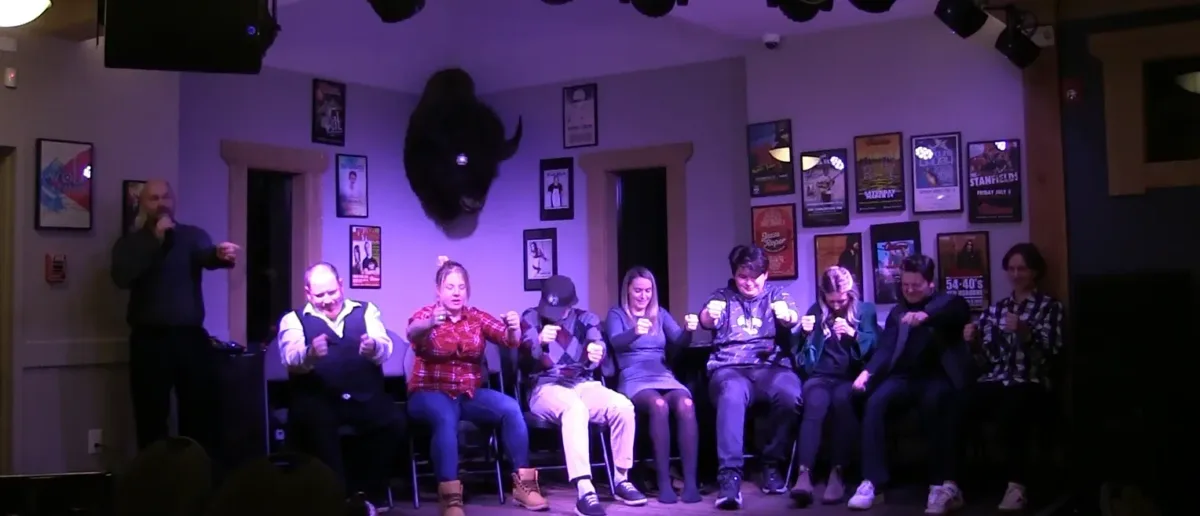
You’ve seen the videos. A group of accountants is suddenly convinced they are world-class air guitarists. A stoic CEO starts speaking a “forgotten Martian language.” From the outside, it looks like a mix of magic, mischief, and maybe a bit of “paid acting.”
As an event planner, your reputation is on the line with every booking. You need to know: Is stage hypnosis real, or are you just hiring a very clever prankster?
I’ve spent years on stages across Canada, from intimate corporate boardrooms to massive fundraisers. I’ve seen the skepticism in the eyes of HR directors before the show, and the utter disbelief in the laughter of those same directors afterward.
The truth is more fascinating than the myths. It isn’t about “zombies” or “mind control.” It’s about momentum, psychology, and the power of human imagination.
Here are five fundamental truths about stage hypnosis that every event planner needs to understand before they sign the contract.
1. It’s Not “Sleep”, It’s Super-Charged Focus
One of the biggest hurdles for planners is the word “sleep.” In a hypnotic context, “sleep” is just shorthand for a state of deep, focused relaxation.
When a volunteer is on stage with me, they aren’t unconscious. In fact, their brain is more active in certain ways than yours is while you’re sitting in the audience. They are in a state of hyper-suggestibility.
Think of it like this: have you ever been so engrossed in a movie that you didn’t hear someone call your name? Or have you ever driven home and realized you don’t remember the last three miles? That’s a natural hypnotic state. On stage, we simply amplify that focus.
The takeaway? Your guests are always aware, always safe, and always in the room. They are simply operating in a mental space where the “internal critic”, the part of the brain that says, “I shouldn’t do this, it’s silly”, is temporarily turned down.
2. You Cannot Be Hypnotized Against Your Will

“What if the hypnotist makes me do something I don’t want to do?”
This is the number one question I get. Here is a universal truth: Stage hypnosis requires cooperation, not submission.
If I tell a volunteer to do something that violates their core values or makes them feel truly unsafe, their “internal guardian” will snap them right out of it. My job isn’t to “control” them; it’s to invite them into a performance where they are the stars.
For an event planner, this is your safety net. The people who come up on stage are the ones who want to be there. They are the “high-responders” who are ready to play. We use “suggestibility tests” at the start of every show to identify these individuals, ensuring the show has the right ingredients for success it needs to succeed.
3. High-Energy Comedy Doesn’t Have to Be “Blue”
There is a common misconception that for a comedy show to be “uproarious,” it has to be “edgy” or embarrassing. In a corporate environment, that’s a non-starter.
My philosophy is simple: The volunteers are the stars of the show.
If the audience is laughing at someone’s expense, I’ve failed. If they are laughing with someone because they are seeing a side of their colleague they never knew existed, the hidden rockstar, the hilarious improv artist, then we’ve created a meaningful moment.
A professional stage hypnosis show is 100% clean. It’s HR-friendly, family-friendly, and designed to leave everyone feeling better than when they arrived. We don’t need “blue” humor when we have the natural, spellbinding creativity of the human mind.
4. Logistics: It Scales to Your Success

Planners often worry if a show will work for their specific room size. Whether you have 30 people in a private dining room or 3,000 in a convention center, getting a quote for your event is a simple next step to see what fits best.
- Small Groups: Create an intimate, “how did he do that?” vibe where everyone feels like they are part of the inner circle.
- Large Crowds: The energy is infectious. When 500 people laugh at once, the “social proof” makes the hypnotic state even deeper for those on stage.
From a pragmatic standpoint, you don’t need a Broadway-level lighting rig. A clear stage area, a good sound system, and a row of chairs are the primary requirements. The real “special effects” are provided by the volunteers’ imaginations.
5. The ROI is Emotional Connection
Why book stage hypnosis instead of a standard stand-up comic or a band? Because of the “experience” factor.
A band provides a backdrop. A comedian provides a monologue. A hypnotist provides a shared memory that involves the actual people in the room.
Weeks after the event, your team won’t be talking about the chicken dinner. They’ll be talking about the time Dave from Accounting “won” a horse race on a folding chair. That kind of real client feedback is the real currency of a successful event. It drives attendance for future events and builds a culture of joy and connection.
Is It Real?

Yes, it’s real. But it’s not supernatural.
It is a sophisticated blend of psychology, showmanship, and social dynamics. When done correctly, it’s the most engaging form of entertainment available for corporate events. It takes the “risk” out of the “unknown” by putting the focus squarely on the fun.
If you’re looking to transform your next staff party, fundraiser, or conference into something truly memorable, I’m here to help you navigate the logistics.
Let’s make your volunteers the stars.
Ready to see it in action?
Check availability and pricing or reach out to chat about how we can tailor a performance to your specific goals. Let’s create something spellbinding together.